
Artificial Intelligence has evolved rapidly over the last few years, but one of the most important developments in 2026 is the rise of AI Agents.
Unlike traditional software that waits for human instructions, AI Agents can perform tasks, make decisions, follow workflows, and interact with multiple business systems automatically. For small and medium-sized businesses, this technology is becoming a powerful tool for reducing manual work, improving efficiency, and increasing productivity.
Businesses that previously relied on spreadsheets, emails, phone calls, and repetitive administrative processes are now using AI Agents to automate large parts of their daily operations.
In this guide, we will explore what AI Agents are, how they work, and how businesses are using them to replace manual tasks in 2026.
What Are AI Agents?
An AI Agent is an intelligent software system designed to perform specific tasks with minimal human intervention.
Unlike a simple chatbot, an AI Agent can:
- Collect information
- Analyze data
- Make decisions based on rules
- Execute actions
- Communicate with other software systems
- Learn from interactions
Think of an AI Agent as a digital employee that can handle repetitive tasks continuously without becoming tired or distracted.
For example, an AI Agent can:
- Monitor incoming leads
- Assign customer inquiries to the correct team
- Schedule follow-up tasks
- Generate reports
- Send reminders automatically
All without requiring manual input.
Why Businesses Are Adopting AI Agents
Companies are under constant pressure to do more with fewer resources.
Hiring additional employees increases costs, while manual processes often slow down growth.
AI Agents help solve these challenges by:
- Reducing repetitive work
- Improving accuracy
- Operating 24/7
- Processing information faster
- Supporting employees rather than replacing them
As a result, businesses can scale operations without increasing overhead costs at the same rate.
AI Agents for Customer Follow-Up
One of the most common uses of AI Agents is customer relationship management.
Many businesses lose potential sales because leads are forgotten or follow-up happens too late.
An AI Agent can:
- Capture lead information automatically
- Store customer data in a CRM
- Schedule reminders
- Send personalized follow-up messages
- Notify sales representatives when action is required
Instead of relying on memory or manual tracking, businesses create a structured follow-up process that improves conversion rates.
AI Agents in Customer Support
Customer support teams often spend significant time answering repetitive questions.
AI Agents can instantly handle common requests such as:
- Product availability
- Pricing information
- Appointment booking
- Order status updates
- Business hours
When a question requires human expertise, the AI Agent can transfer the conversation to the appropriate employee.
This approach reduces response times while improving customer satisfaction.
AI Agents for Marketing Automation
Marketing involves many repetitive activities that consume valuable time.
Businesses are now using AI Agents to:
- Generate content ideas
- Schedule social media posts
- Analyze campaign performance
- Segment customer audiences
- Personalize marketing messages
Instead of manually managing every step, marketing teams can focus on strategy and creativity while AI handles execution and analysis.
AI Agents in Sales Operations
Sales teams often spend more time managing data than actually selling.
AI Agents help by:
- Qualifying leads automatically
- Prioritizing opportunities
- Tracking customer interactions
- Preparing sales reports
- Identifying high-value prospects
This allows sales representatives to focus on building relationships and closing deals.
For many businesses, this leads to higher conversion rates and improved revenue growth.
AI Agents for Internal Workflows
Administrative tasks are essential but often consume a large portion of employee time.
Examples include:
- Data entry
- Invoice processing
- Document management
- Employee onboarding
- Task assignment
AI Agents can automate these workflows, ensuring consistency while reducing manual effort.
Employees spend less time on repetitive work and more time on activities that create value for customers.
AI Agents and Business Reporting
Business decisions depend on accurate information.
Many managers still rely on manually prepared reports that require hours of work every week.
AI Agents can automatically:
- Collect data from multiple systems
- Generate dashboards
- Identify trends
- Highlight performance issues
- Send scheduled reports
This gives business leaders real-time visibility into operations and enables faster decision-making.
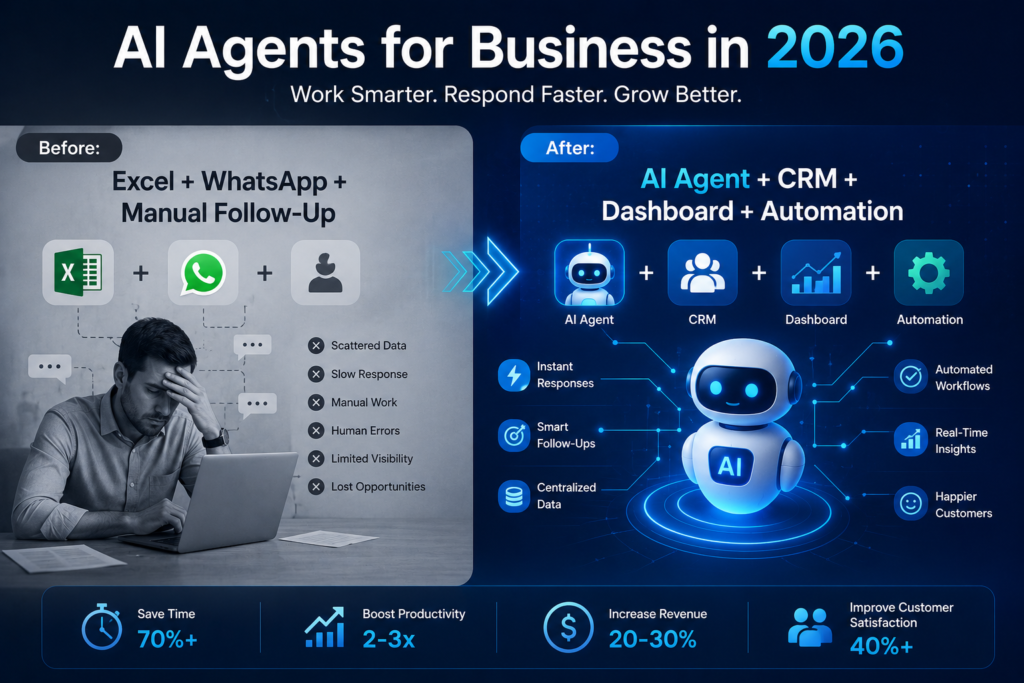
Real-World Example: Lead Management
Consider a small business receiving 150 customer inquiries every month.
Without automation:
- Leads arrive through WhatsApp, email, and social media.
- Information is stored in multiple locations.
- Follow-ups are inconsistent.
- Opportunities are lost.
With an AI Agent:
- Every lead is captured automatically.
- Customer information is centralized.
- Follow-up schedules are generated.
- Sales performance is tracked.
The business becomes more organized and significantly improves its ability to convert inquiries into customers.
Common Myths About AI Agents
AI Agents Replace Employees
This is one of the biggest misconceptions.
In most businesses, AI Agents handle repetitive tasks while employees focus on decision-making, creativity, customer relationships, and problem-solving.
AI Agents Are Only for Large Companies
Modern AI tools are becoming increasingly affordable and accessible.
Small businesses can implement AI Agents without investing in expensive enterprise systems.
AI Agents Require Technical Expertise
Many modern platforms offer no-code or low-code solutions, allowing businesses to build automations without advanced programming knowledge.
How to Start Using AI Agents
Businesses should begin with one process rather than attempting to automate everything at once.
A simple implementation plan includes:
- Identify repetitive tasks.
- Measure time spent on those tasks.
- Select an AI tool that solves the problem.
- Test automation on a small scale.
- Monitor results.
- Expand gradually.
This approach reduces risk while allowing teams to adapt to new workflows.
The Future of AI Agents
The capabilities of AI Agents continue to improve rapidly.
In the coming years, businesses will use AI Agents to:
- Manage customer journeys
- Coordinate marketing campaigns
- Optimize inventory levels
- Support sales teams
- Generate business insights
- Automate operational workflows
Organizations that adopt these technologies early will gain significant competitive advantages.
Frequently Asked Questions
What is an AI Agent?
An AI Agent is an intelligent software system capable of performing tasks, making decisions, and interacting with business systems with minimal human intervention.
How are AI Agents different from chatbots?
Chatbots primarily answer questions, while AI Agents can perform actions, execute workflows, and automate business processes.
Can small businesses use AI Agents?
Yes. Many affordable AI platforms now provide AI Agent functionality suitable for small and medium-sized businesses.
Do AI Agents require coding?
Not always. Many modern tools offer no-code solutions that allow businesses to create automations without programming knowledge.
Are AI Agents secure?
When implemented properly using trusted platforms and security practices, AI Agents can operate safely within business environments.
Conclusion
AI Agents are transforming the way businesses operate in 2026. By automating repetitive tasks, improving customer management, supporting sales teams, and generating business insights, these intelligent systems help organizations work more efficiently and scale more effectively.
Rather than replacing employees, AI Agents allow teams to focus on higher-value activities that drive growth and improve customer experiences.
For businesses looking to remain competitive in an increasingly digital world, adopting AI Agents is quickly becoming a strategic necessity rather than an optional innovation.
Related Articles