
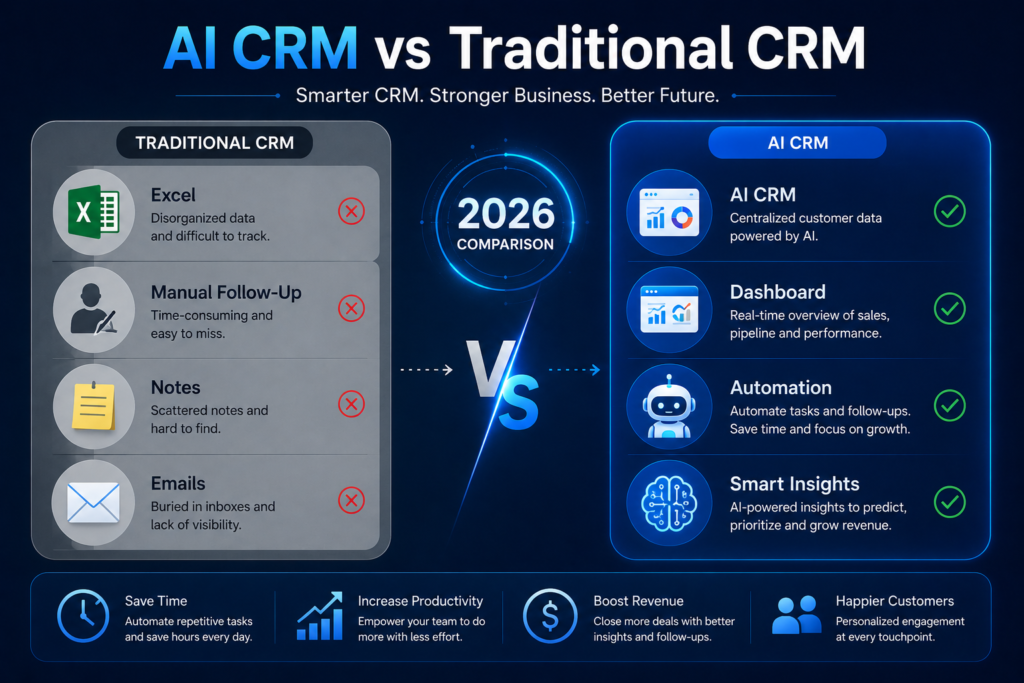
Customer Relationship Management (CRM) systems have been helping businesses organize customer information, manage sales activities, and improve customer service for decades. However, the rise of Artificial Intelligence is changing the way CRM platforms operate.
In 2026, businesses are increasingly faced with an important question:
Should you continue using a traditional CRM system, or should you switch to an AI-powered CRM?
The answer depends on your business goals, sales processes, and growth plans. In this guide, we will compare AI CRM and Traditional CRM systems, explore their advantages and limitations, and help you determine which option is best for your business.
What Is a Traditional CRM?
A traditional CRM is software designed to store and organize customer information.
It helps businesses:
- Manage customer contacts
- Track sales opportunities
- Record customer interactions
- Monitor sales pipelines
- Generate reports
Popular CRM platforms have helped businesses improve organization and visibility for many years.
However, traditional CRM systems still require significant manual input from employees.
Users must:
- Enter customer information
- Update records
- Create tasks
- Schedule follow-ups
- Analyze reports
The system stores data, but it usually does not make intelligent recommendations.
What Is an AI CRM?
An AI CRM combines traditional CRM functionality with Artificial Intelligence.
Instead of simply storing information, AI CRM systems actively analyze data and assist users in making decisions.
AI CRM platforms can:
- Automatically capture customer data
- Predict customer behavior
- Prioritize sales opportunities
- Generate follow-up reminders
- Identify sales trends
- Suggest next actions
- Automate repetitive tasks
Rather than acting as a database, an AI CRM becomes an intelligent business assistant.
The Key Difference Between AI CRM and Traditional CRM
The biggest difference is simple:
Traditional CRM Stores Information
AI CRM Uses Information
A traditional CRM helps you organize data.
An AI CRM helps you take action based on that data.
This distinction becomes increasingly important as businesses grow and customer interactions become more complex.
Customer Data Management
Traditional CRM
Employees manually enter and update customer records.
Advantages:
- Full control over information
- Familiar workflow
- Lower complexity
Disadvantages:
- Time-consuming
- Human errors
- Inconsistent updates
AI CRM
AI assists with data collection and maintenance.
Advantages:
- Reduced manual work
- Improved accuracy
- Faster updates
Disadvantages:
- Requires setup and training
- Depends on data quality
For growing businesses, AI CRM significantly reduces administrative effort.
Sales Performance
Sales teams often spend too much time managing data rather than selling.
Traditional CRM
Sales representatives:
- Update opportunities manually
- Create tasks
- Monitor pipelines themselves
Success depends heavily on employee discipline.
AI CRM
The system can:
- Prioritize leads
- Predict buying behavior
- Identify high-value opportunities
- Recommend next actions
This helps sales teams focus on activities that generate revenue.
Customer Follow-Up
One of the biggest reasons businesses lose sales is poor follow-up.
Traditional CRM
Users create reminders manually.
If reminders are missed, opportunities can be lost.
AI CRM
The system automatically:
- Creates follow-up schedules
- Identifies inactive leads
- Sends notifications
- Recommends contact timing
This improves customer engagement and increases conversion rates.
Reporting and Analytics
Business decisions depend on data.
Traditional CRM
Managers often need to:
- Generate reports manually
- Analyze trends themselves
- Build custom dashboards
AI CRM
AI can:
- Detect patterns
- Identify risks
- Highlight opportunities
- Generate insights automatically
This allows faster and more informed decision-making.
Marketing Automation
Marketing is another area where AI CRM provides significant advantages.
Traditional CRM systems typically focus on storing contact information.
AI CRM platforms can additionally:
- Segment audiences
- Personalize campaigns
- Predict customer interests
- Recommend marketing actions
This creates more effective customer communication.
Cost Comparison
Many business owners assume AI CRM systems are significantly more expensive.
In reality, pricing depends on:
- Company size
- Number of users
- Features required
- Automation level
While AI CRM may involve higher subscription costs, businesses often recover those costs through:
- Reduced labor
- Higher sales productivity
- Improved customer retention
- Better operational efficiency
The return on investment can be substantial.
Which Businesses Benefit Most from AI CRM?
AI CRM is particularly valuable for:
- Sales teams
- Marketing agencies
- Service businesses
- Retail companies
- Distributors
- Growing startups
Businesses handling large numbers of customer interactions often see the greatest benefits.
When Traditional CRM May Be Enough
Traditional CRM may still be suitable for:
- Very small teams
- Businesses with limited customer interactions
- Organizations that do not require automation
- Companies with simple sales processes
For these businesses, a traditional CRM can provide sufficient organization without additional complexity.
Real-World Example
Imagine a company receiving 200 customer inquiries every month.
Using a Traditional CRM:
- Employees manually enter data.
- Follow-ups are scheduled manually.
- Reports require additional work.
Using an AI CRM:
- Leads are captured automatically.
- Follow-ups are generated automatically.
- Reports update in real time.
- High-priority opportunities are identified instantly.
The result is a more efficient sales process and improved customer experience.
Frequently Asked Questions
What is an AI CRM?
An AI CRM is a customer relationship management system that uses Artificial Intelligence to automate tasks, analyze customer data, and provide business insights.
Is AI CRM better than Traditional CRM?
Not always. The best choice depends on your business size, goals, and operational requirements.
Can small businesses use AI CRM?
Yes. Many modern AI CRM solutions are affordable and suitable for small businesses.
Does AI CRM replace employees?
No. AI CRM helps employees work more efficiently by reducing repetitive administrative tasks.
Is AI CRM worth the investment?
For many businesses, the increase in productivity and sales performance justifies the investment.
Conclusion
Both Traditional CRM and AI CRM systems can help businesses organize customer information and improve operations. However, AI CRM goes beyond data storage by providing automation, insights, and intelligent recommendations.
As businesses continue to adopt Artificial Intelligence in 2026, AI CRM platforms are becoming an increasingly valuable tool for improving productivity, customer engagement, and sales performance.
The right choice depends on your business needs, but companies focused on growth and efficiency are increasingly moving toward AI-powered CRM solutions.
Related Articles
How AI Agents Are Replacing Manual Business Tasks in 2026
How Small Businesses Are Using AI to Save Time, Reduce Costs, and Increase Sales in 2026