
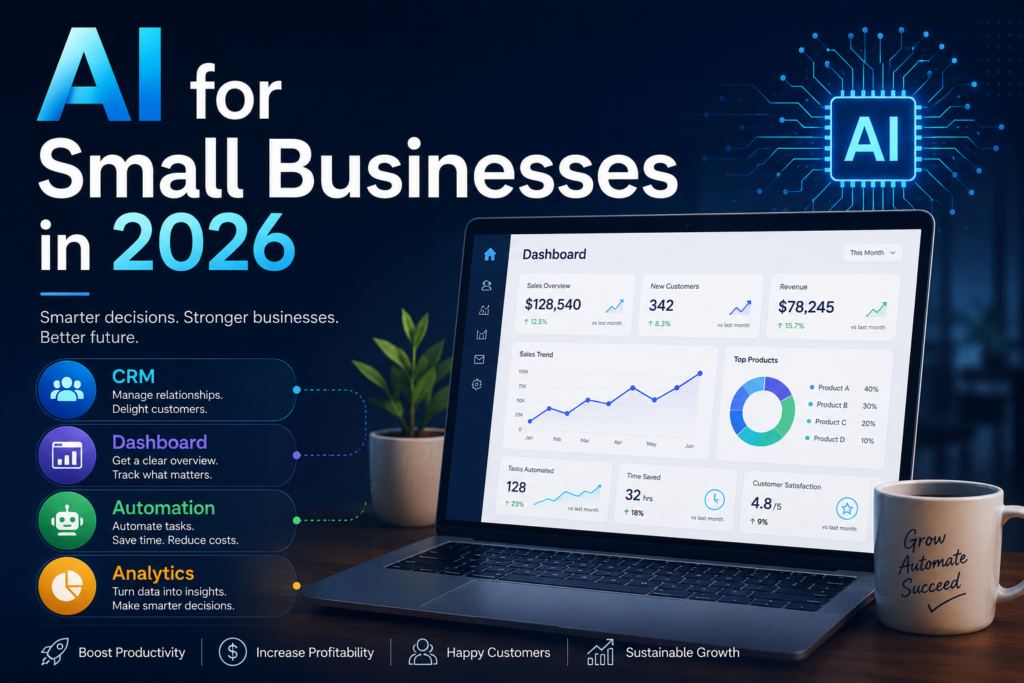
Artificial Intelligence is no longer a futuristic concept. In 2026, it has become one of the most practical tools available to small business owners. While large corporations continue investing millions in advanced AI systems, small businesses are discovering that even simple AI solutions can dramatically improve productivity, reduce operational costs, and increase sales.
The misconception that AI is only for technology companies is rapidly disappearing. Retail stores, marketing agencies, consulting firms, healthcare providers, wholesalers, and service businesses are all using AI to streamline daily operations and gain a competitive advantage.
In this guide, we will explore how small businesses are using AI in 2026, the benefits they are experiencing, and the practical ways any company can begin implementing AI today.
Why AI Matters for Small Businesses
Most small businesses face similar challenges:
- Limited budgets
- Small teams
- Increasing competition
- Manual administrative work
- Difficulty managing customer relationships
- Inefficient marketing efforts
Business owners often spend significant amounts of time performing repetitive tasks instead of focusing on growth.
Artificial Intelligence helps automate these repetitive processes, allowing business owners and employees to focus on higher-value activities such as customer service, sales, strategic planning, and business development.
Instead of replacing employees, AI acts as a productivity multiplier.
AI-Powered Customer Relationship Management (CRM)
Customer follow-up remains one of the biggest challenges for small businesses.
Many companies still manage customer information through spreadsheets, notebooks, WhatsApp conversations, or disconnected software systems.
As the business grows, valuable leads are often forgotten, delayed, or lost entirely.
Modern AI-powered CRM systems solve this problem by:
- Automatically capturing customer information
- Scheduling follow-up reminders
- Tracking customer interactions
- Prioritizing sales opportunities
- Generating performance reports
For example, a wholesale distributor receiving dozens of inquiries every week can use AI to identify which customers are most likely to place orders, allowing sales representatives to focus their efforts where they generate the highest return.
Automating Customer Support
Customers expect quick answers.
Waiting hours or days for a response can result in lost sales and damaged trust.
AI-powered chat assistants now allow businesses to provide instant support around the clock.
Common tasks handled by AI support systems include:
- Product information
- Frequently asked questions
- Appointment scheduling
- Order status updates
- Pricing inquiries
- Lead qualification
This improves customer satisfaction while reducing the workload on staff members.
Even small businesses can now provide customer experiences that were previously only available to large organizations.
AI for Marketing and Content Creation
Creating high-quality marketing content consistently can be difficult and time-consuming.
Business owners often struggle to maintain active social media accounts, publish blog articles, write advertising copy, and manage email campaigns.
AI tools help accelerate content creation by generating:
- Blog articles
- Social media posts
- Advertising copy
- Product descriptions
- Landing page content
- Email marketing campaigns
Instead of starting from a blank page, marketers can use AI-generated drafts and then customize them to match their brand voice and objectives.
This significantly reduces content production time while maintaining quality.
Improving Sales Performance with AI
One of the most valuable applications of AI is sales optimization.
AI systems can analyze customer behavior and identify patterns that would be difficult for humans to detect manually.
Businesses can use AI to:
- Predict customer purchasing behavior
- Identify best-selling products
- Detect declining sales trends
- Recommend cross-selling opportunities
- Improve customer retention
By using data-driven insights, companies make better decisions and increase revenue.
For small businesses operating in competitive markets, these insights can become a major advantage.
AI and Business Automation
Many companies still waste valuable hours performing routine administrative tasks.
Examples include:
- Data entry
- Inventory tracking
- Report generation
- Invoice management
- Appointment scheduling
- Internal communication
AI-powered automation platforms can handle these tasks automatically.
The result is:
- Fewer errors
- Faster workflows
- Lower operational costs
- Increased efficiency
Business owners gain more visibility into operations while employees spend less time on repetitive work.
AI for Inventory Management
Inventory management remains a challenge for retailers, wholesalers, and distributors.
Excess inventory ties up capital, while stock shortages result in lost sales.
AI helps businesses:
- Forecast demand
- Predict seasonal trends
- Identify slow-moving products
- Optimize stock levels
- Reduce inventory costs
Instead of relying solely on historical data and intuition, businesses can use AI-driven recommendations to make smarter purchasing decisions.
AI in Lead Generation
Finding new customers consistently is one of the most important business activities.
AI tools can assist with:
- Lead qualification
- Audience targeting
- Advertising optimization
- Email outreach
- Customer segmentation
Marketing campaigns become more efficient because AI helps identify which prospects are most likely to convert into paying customers.
This reduces advertising waste and improves return on investment.
Real-World Example
Imagine a small marketing agency handling 100 inquiries every month.
Without AI:
- Leads are scattered across WhatsApp and email.
- Follow-ups are inconsistent.
- Reporting is manual.
- Sales opportunities are lost.
With AI-powered systems:
- Every lead is recorded automatically.
- Follow-up tasks are generated.
- Customer communication is tracked.
- Performance reports are updated in real time.
The agency becomes more organized, more responsive, and more profitable.
Common Mistakes Businesses Make with AI
While AI offers significant benefits, many businesses make mistakes when implementing it.
Common errors include:
Trying to automate everything at once
Successful businesses start with one process and expand gradually.
Choosing tools without a clear objective
Every AI implementation should solve a specific business problem.
Ignoring employee training
Staff members should understand how AI supports their work.
Expecting AI to replace human judgment
AI provides recommendations and automation, but human oversight remains essential.
How to Start Using AI in Your Business
If your company is new to AI, begin with these steps:
- Identify repetitive tasks.
- Select one process to automate.
- Implement a simple AI tool.
- Measure results.
- Expand gradually based on success.
The businesses achieving the greatest success with AI are not necessarily the largest companies. They are the companies that consistently improve their processes over time.
The Future of AI for Small Businesses
The role of AI will continue expanding over the next decade.
Businesses that adopt AI today will benefit from:
- Faster growth
- Better customer experiences
- Increased operational efficiency
- Improved decision-making
- Greater competitiveness
The companies that delay adoption may struggle to compete against organizations that operate more efficiently through automation and data-driven processes.
Frequently Asked Questions
What is AI for small businesses?
AI helps small businesses automate repetitive tasks, improve customer service, reduce costs, and increase productivity.
Conclusion
Artificial Intelligence is transforming the way small businesses operate in 2026. From customer relationship management and sales optimization to marketing automation and inventory control, AI provides practical solutions that help businesses save time, reduce costs, and increase revenue.
The most successful businesses are not using AI to replace people. They are using AI to help people work smarter, make better decisions, and deliver better results.
For small business owners, the question is no longer whether AI should be adopted. The question is how quickly they can begin implementing it to stay competitive in an increasingly digital marketplace.