
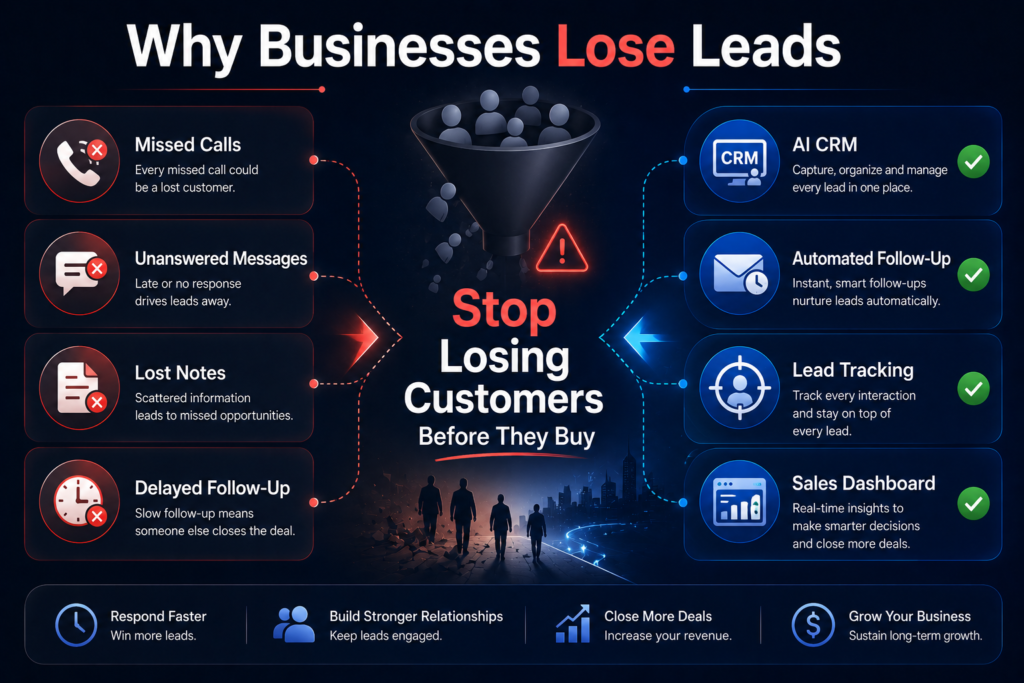
Every business wants more leads. However, generating leads is only part of the equation. The real challenge is converting those leads into paying customers.
Many small businesses invest heavily in advertising, social media marketing, websites, and lead generation campaigns. Yet despite attracting potential customers, they still struggle to increase sales.
The reason is often simple: they are losing leads throughout the sales process.
In 2026, businesses are discovering that the problem is not always a lack of leads. Instead, it is poor lead management, inconsistent follow-up, and inefficient systems.
This guide explains why small businesses lose leads and how Artificial Intelligence is helping solve this problem.
What Is a Lead?
A lead is a potential customer who has expressed interest in your products or services.
Examples include:
- Someone filling out a contact form
- A customer sending a WhatsApp message
- A website inquiry
- A phone call
- A social media message
- An email inquiry
Every lead represents a potential sales opportunity.
The problem is that many businesses fail to manage those opportunities effectively.
The Hidden Cost of Lost Leads
When businesses think about losses, they often focus on:
- Advertising expenses
- Operational costs
- Employee salaries
However, lost leads may be one of the most expensive hidden costs.
Consider this example:
A business receives 200 inquiries per month.
If only 10% convert into customers, that means 180 opportunities are lost.
Even a small improvement in lead management can have a significant impact on revenue.
Why Small Businesses Lose Leads
1. Slow Response Times
Modern customers expect quick responses.
Research consistently shows that the likelihood of converting a lead decreases as response time increases.
Many small businesses:
- Respond hours later
- Respond the next day
- Forget to respond entirely
By the time a reply arrives, the customer may have already contacted a competitor.
2. No Centralized Lead System
Customer inquiries often arrive from multiple channels:
- Phone calls
- Website forms
Without a centralized system, customer information becomes scattered.
This makes it difficult to track conversations and maintain consistent follow-up.
3. Poor Follow-Up Processes
Many sales opportunities are not lost because customers said no.
They are lost because nobody followed up.
Business owners frequently assume:
- The customer will contact them again.
- Interested customers will remember.
- One message is enough.
In reality, many sales require multiple interactions before a customer makes a decision.
4. Lack of Lead Prioritization
Not every lead has the same value.
Some customers are ready to buy immediately.
Others are simply researching options.
Without a proper system, sales teams often spend time on low-priority opportunities while high-value prospects receive less attention.
5. Human Error
Employees are busy.
Tasks are forgotten.
Notes are misplaced.
Reminders are missed.
Human error is unavoidable when businesses rely entirely on manual processes.
6. No Visibility Into the Sales Pipeline
Many business owners cannot answer simple questions such as:
- How many leads arrived this month?
- How many were contacted?
- How many converted?
- Which marketing channel performs best?
Without visibility, improving performance becomes difficult.
How AI Solves Lead Management Problems
Artificial Intelligence helps businesses create structured and scalable lead management systems.
Instead of relying on memory and manual processes, AI helps automate critical activities.
AI Improves Response Speed
AI-powered systems can:
- Instantly acknowledge inquiries
- Provide initial information
- Route customers to the correct team
- Schedule follow-up actions
This ensures customers receive attention immediately.
AI Centralizes Customer Information
AI-powered CRM systems collect customer information from multiple channels and store it in one location.
Benefits include:
- Better organization
- Improved communication
- Easier tracking
- Complete customer history
Businesses gain a clearer view of every interaction.
AI Automates Follow-Up
One of the most powerful applications of AI is automated follow-up.
The system can:
- Create reminders
- Schedule tasks
- Send messages
- Identify inactive leads
This ensures opportunities are not forgotten.
AI Prioritizes High-Value Leads
Modern AI systems can analyze customer behavior and identify which leads are most likely to convert.
This helps businesses:
- Focus on qualified prospects
- Improve sales efficiency
- Increase conversion rates
Instead of treating every lead equally, teams focus on the best opportunities.
AI Provides Actionable Insights
AI can analyze sales data and identify patterns.
For example:
- Which channels generate the best leads?
- Which products attract the most inquiries?
- Which sales representatives perform best?
- Where are leads being lost?
These insights help businesses make smarter decisions.
Real Example: Before and After AI
Before AI
- Leads arrive through WhatsApp and email.
- Customer information is scattered.
- Follow-up depends on memory.
- Sales opportunities are lost.
After AI
- Leads are captured automatically.
- Customer records are centralized.
- Follow-up is automated.
- Performance is tracked.
- Sales teams focus on high-priority opportunities.
The result is a more organized and efficient sales process.
Signs Your Business Is Losing Leads
You may have a lead management problem if:
- Customers complain about slow responses.
- Follow-up is inconsistent.
- Leads are stored in multiple locations.
- Sales performance is difficult to measure.
- Employees rely on spreadsheets and notes.
- Opportunities are frequently forgotten.
These are strong indicators that automation and AI can help.
How to Start Improving Lead Management
Step 1:
Track every lead in one system.
Step 3:
Create a structured follow-up process.
Step 2:
Measure response times.
Step 4:
Implement a CRM platform.
Step 5:
Use AI to automate repetitive tasks.
Step 6:
Monitor conversion rates and continuously improve.
Small improvements can produce significant results over time.
Frequently Asked Questions
Why do businesses lose leads?
Businesses typically lose leads because of slow response times, poor follow-up, scattered customer information, and lack of sales processes.
What is lead management?
Lead management is the process of tracking, organizing, nurturing, and converting potential customers into paying customers.
Can AI increase lead conversion rates?
Yes. AI can automate follow-up, prioritize opportunities, and improve response times, leading to better conversion rates.
What is the best way to track leads?
A CRM system is generally the most effective way to manage and track customer inquiries.
Do small businesses need AI for lead management?
Not always, but AI can significantly improve efficiency and help businesses scale without increasing administrative work.
Conclusion
Many small businesses believe they need more leads when the real problem is that they are losing the leads they already have.
Slow responses, inconsistent follow-up, scattered customer information, and manual processes create unnecessary revenue loss.
Artificial Intelligence helps solve these problems by automating lead management, improving visibility, accelerating follow-up, and providing valuable business insights.
In 2026, businesses that combine AI, CRM systems, and automation are better equipped to convert inquiries into customers and build scalable sales processes that support long-term growth.